
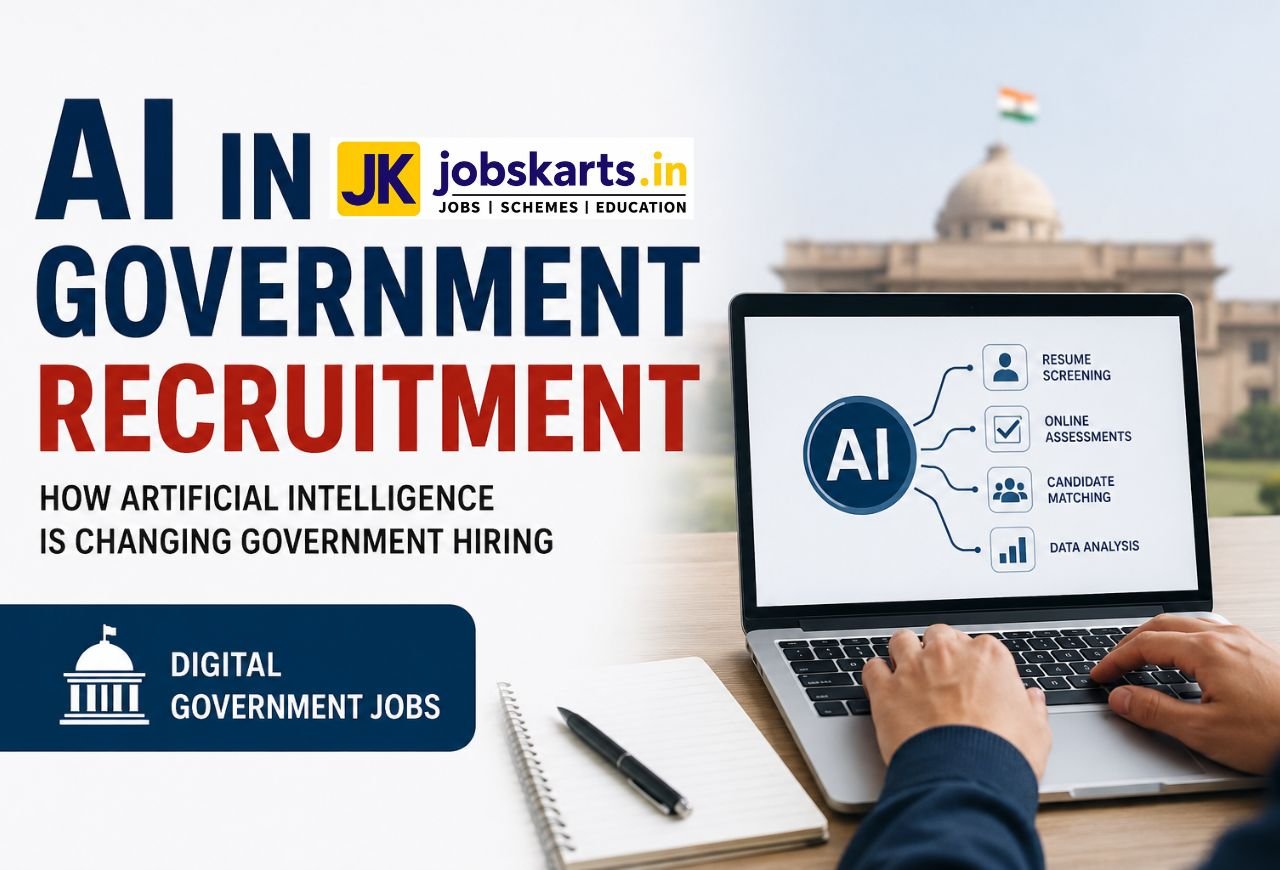
Artificial Intelligence (AI) is rapidly changing the way governments recruit employees across different departments and public sector organizations. From screening applications to conducting online assessments, the Government Hiring Process is becoming faster, more transparent, and more efficient through technology. As governments move toward digital governance, the use of Artificial Intelligence in Recruitment is helping agencies manage large numbers of applicants while reducing manual workload. Understanding the role of the AI Recruitment System has become important for students and job seekers preparing for Digital Government Jobs in the coming years.
Key Details
| Particulars | Details |
|---|---|
| Topic | AI in Government Recruitment |
| Main Technology | Artificial Intelligence (AI) |
| Purpose | Improve hiring efficiency and transparency |
| Key Applications | Resume screening, assessments, data analysis |
| Benefits | Faster recruitment, reduced human error |
| Challenges | Bias concerns, data privacy, transparency |
| Impact on Candidates | More digital and skill-based recruitment |
| Future Trend | Increased automation in government hiring |
What is an AI Recruitment System?
An AI Recruitment System is a technology-based hiring solution that uses machine learning, data analysis, and automation tools to support recruitment activities. Instead of manually reviewing thousands of applications, AI systems can quickly analyze candidate information, identify suitable applicants, and organize recruitment data. In government recruitment, these systems are increasingly being used to manage large-scale examinations, application verification, document screening, and candidate communication. The goal is not to replace human decision-makers but to improve efficiency and accuracy throughout the recruitment process.
How Artificial Intelligence is Changing the Government Hiring Process
The traditional Government Hiring Process often involves lengthy application reviews, manual document verification, and multiple administrative steps. Artificial Intelligence helps automate many of these tasks, allowing recruitment agencies to process applications more quickly. AI-powered systems can identify incomplete applications, verify eligibility criteria, detect duplicate entries, and assist in scheduling examinations or interviews. This digital transformation reduces delays and enables government departments to handle recruitment drives involving lakhs of applicants more effectively.
Major Uses of Artificial Intelligence in Recruitment
The use of Artificial Intelligence in Recruitment extends across several stages of hiring. AI tools can analyze resumes, match candidate qualifications with job requirements, and rank applications based on predefined criteria. Online examination systems can use AI-based monitoring to maintain exam integrity and reduce unfair practices. Chatbots are also becoming common for answering applicant queries, providing updates, and guiding candidates through application procedures. These innovations help improve candidate experience while reducing administrative burdens on government agencies.
Traditional Recruitment vs AI-Based Recruitment
| Feature | Traditional Recruitment | AI-Based Recruitment |
|---|---|---|
| Application Screening | Manual review | Automated analysis |
| Processing Speed | Slow | Fast |
| Error Rate | Higher possibility | Lower possibility |
| Candidate Communication | Mostly manual | Automated notifications |
| Data Management | Paper-heavy or manual | Digital and centralized |
| Scalability | Limited | Can handle large applicant volumes |
Benefits of AI in Digital Government Jobs
The growing use of AI in Digital Government Jobs offers several advantages. Recruitment agencies can save time, reduce operational costs, and improve consistency in candidate evaluation. AI systems can process large amounts of information within minutes, making recruitment drives more efficient. Transparency can also improve when standardized algorithms are used to assess candidates based on objective criteria. Additionally, digital recruitment platforms make it easier for applicants from different regions to participate in government hiring processes without extensive paperwork.
Challenges and Concerns of AI-Based Recruitment
While AI offers many benefits, certain challenges must be addressed. Algorithms are only as fair as the data used to train them, which means bias can sometimes enter automated decision-making processes. Data privacy and cybersecurity are also important concerns because recruitment systems handle sensitive personal information. Governments must ensure that AI systems remain transparent, accountable, and compliant with legal and ethical standards. Human oversight continues to play a critical role in ensuring fairness and accuracy throughout the recruitment process.
Career Impact: What Job Seekers Should Know
The increasing use of AI in recruitment does not reduce employment opportunities; instead, it changes how candidates are evaluated. Job seekers may face more online assessments, digital verification processes, and technology-enabled screening methods. As a result, candidates should focus on developing digital literacy, communication skills, analytical thinking, and problem-solving abilities. Understanding online recruitment platforms and adapting to digital examination systems can improve a candidate’s chances of success in future government hiring cycles.
Student Advice
Students preparing for future government careers should start building strong digital skills alongside traditional academic preparation. Familiarity with online application systems, computer-based examinations, digital documentation, and basic technology concepts will be valuable as recruitment processes continue to modernize. Candidates should also keep their educational records organized, regularly update their skills, and stay informed about emerging technologies affecting public sector employment. Developing adaptability and continuous learning habits will help students remain competitive in an increasingly technology-driven job market.
The Future of Artificial Intelligence in Government Recruitment
The future of Artificial Intelligence in Recruitment is expected to involve more advanced automation, predictive analytics, and intelligent decision-support systems. Governments around the world are investing in digital transformation initiatives that aim to make hiring faster, more transparent, and more accessible. While human recruiters will continue to play an important role, AI will increasingly assist in administrative tasks, candidate assessment, and workforce planning. As technology evolves, recruitment systems are likely to become more efficient while maintaining a balance between automation and human judgment.
Conclusion
Artificial Intelligence is reshaping the modern Government Hiring Process by improving efficiency, reducing administrative workload, and supporting data-driven decision-making. The rise of the AI Recruitment System marks an important step toward more transparent and accessible public sector hiring. For students and job seekers interested in Digital Government Jobs, understanding these technological changes can provide a significant advantage. As governments continue adopting innovative recruitment solutions, candidates who combine strong academic qualifications with digital skills will be better prepared for future opportunities.
FAQ
What is an AI Recruitment System?
An AI Recruitment System is a technology-based hiring platform that uses artificial intelligence to automate tasks such as application screening, candidate evaluation, and recruitment management.
How does Artificial Intelligence help in government recruitment?
AI helps by speeding up application processing, improving data management, supporting online assessments, and reducing manual administrative work.
Will AI replace human recruiters in government jobs?
No. AI is mainly used as a support tool. Human recruiters still make important decisions and oversee the fairness of the recruitment process.
What skills should students develop for future digital government jobs?
Students should focus on digital literacy, computer skills, analytical thinking, communication abilities, and familiarity with online recruitment systems.